

Discover the $1.55 Million Musgo Sign: Significance and Details
On August 27, 2022, a 48-inch porcelain Musgo Gasoline Sign sold for $1,552,500 at Richmond Auctions in Greenville, South Carolina. That hammer-plus-premium price more than tripled the previous world record for an antique advertising sign and reset what collectors thought a single piece of petroliana could bring.
The sign was not a famous national brand. It was not hanging on a restored Route 66 station. It came out of a Michigan attic, still carrying factory gloss, and it had never been offered to the public. For anyone who collects vintage porcelain signs — or who just found an old gas sign in a barn — the Musgo sale is the story that explains how rarity, condition, and a short-lived brand can collide.
The Musgo Gasoline Sign That Broke the Auction Record
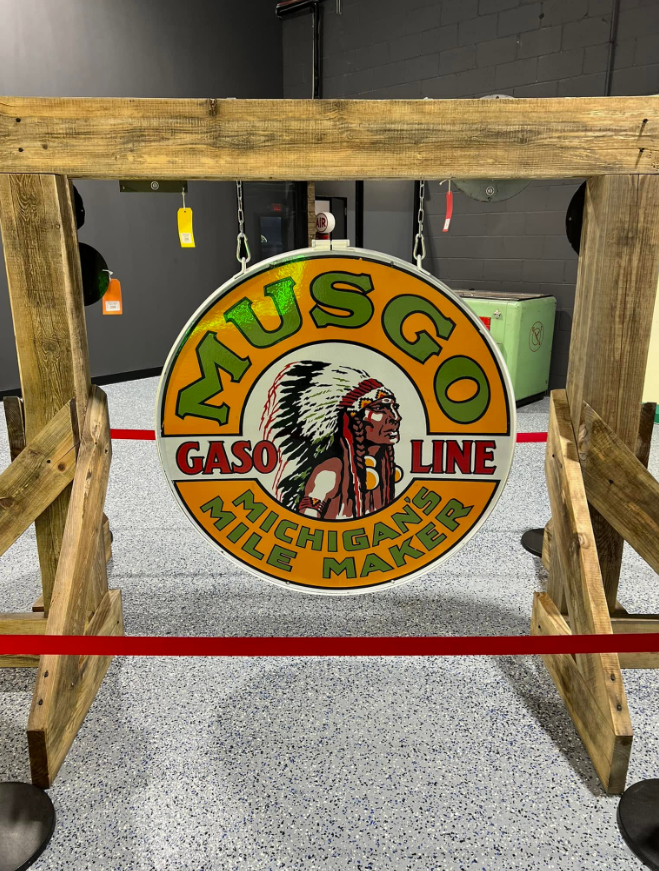
Richmond Auctions cataloged the piece as a 48-inch (it measures 47 7/8 inches) double-sided porcelain (DSP) sign marked Veribrite Signs Chicago. The Authentication Company graded the two faces TAC 9.5 and 9.25 (TAC #041669). The 9.5 side was described as free of blemishes. The reverse showed only a tiny bruise above the headdress and a pencil-eraser-size factory rust speck near the letter “A” in GASOLINE.
The pre-sale estimate sat between $100,000 and $750,000. Absentee bidding opened a month early. On sale day the auctioneer opened at the high absentee bid of $400,000 and climbed in $10,000 steps. About ten minutes later the lot closed at $1.55 million including the 15 percent buyer’s premium. The previous advertised record for an antique advertising sign was $400,000.
The buyer asked to stay anonymous. Richmond later said the purchaser lives in the United States, is not local to Greenville, and planned to make the sign the centerpiece of a small collection. The piece was hand-delivered after the sale.

Why Collectors Call It the Holy Grail of Gas Signs
Musgo was a regional gasoline brand out of Muskegon, Michigan. Surviving records are thin. Most accounts place the company in the mid-to-late 1920s and say it lasted only a few months — some sources say less than six months, others allow as much as a year or two. Pump globes associated with the brand have been reported with a 1929 date stamp, which is why catalogs often date the signs to circa 1929 even when the corporate story is incomplete.
That short life is the first reason originals are scarce. The second reason is what happened after the company folded. A widely repeated account in the hobby is that leftover station signs were reused by a plumber as septic-tank lids. Fumes and moisture ate one face of almost every example that went into that second life. Jordan Richmond has estimated that only about 18 to 20 Musgo signs are known at all, and that only two or three escaped the septic-lid fate.
The record sign was one of those survivors. It was found in an attic in Michigan and treated as new old stock: never hung outdoors, never restored, never “improved.” In porcelain collecting, that combination — rare graphic, correct 48-inch factory size, double-sided format, and near-mint unrestored enamel — is what turns a regional no-name into a seven-figure object.
What the graphic actually shows
The design is a six-color porcelain enamel disc. A profile of a Native American man in a full feathered headdress sits in a white center circle. MUSGO arches across the top in green. GASO / LINE splits in red across the middle. MICHIGAN’S MILE MAKER fills the lower yellow band. The palette is yellow, green, red, black, white, and warm brown — high contrast, readable from the road, and instantly recognizable once you have seen one original.
Veribrite Signs of Chicago made it. That factory produced porcelain enamel advertising for many of the brands collectors chase today, including oil, soda, and farm names. A Veribrite stamp on a period piece is a useful authentication clue, but it is not proof by itself. Reproductions copy the look. They do not copy the steel gauge, the layered glass enamel, or the exact 48-inch commercial size.
Musgo Gasoline Sign Specs at a Glance
| Detail | Record example (August 27, 2022) |
|---|---|
| Sale price | $1,552,500 (includes buyer’s premium) |
| Auction | Richmond Auctions, Greenville, S.C. |
| Estimate | $100,000 – $750,000 |
| Previous category record | About $400,000 |
| Size | 48 inches (cataloged at 47 7/8″) |
| Format | Double-sided porcelain (DSP) |
| Maker | Veribrite Signs, Chicago |
| Grade | TAC 9.5 / 9.25 (TAC #041669) |
| Condition notes | NOS attic find; no restoration; tiny reverse bruise and one factory rust speck |
| Slogan | Michigan’s Mile Maker |
| Known originals | Roughly 18–20; most damaged |
Use this quick filter before you spend real money:
- Size: Original station sign = about 48 inches. Smaller sizes are almost always new.
- Weight: Period porcelain is kiln-fired glass on heavy steel. A four-foot original feels substantial. Thin aluminum or light tin is a giveaway.
- Surface: Real enamel has glassy depth. You can often feel slight ridges where colors were stacked and fired. Flat printed “patina” is not porcelain.
- Chips: Original chips break like glass and show layered color down to dark steel. Painted or vinyl copies peel.
- Story: “Barn fresh 14-inch Musgo porcelain” is a red flag. The record piece was 48 inches and still made news because almost none survived that clean.
A later Musgo that sold with septic damage and restoration still brought serious money — but nowhere near $1.55 million. Condition is not a footnote on this brand. It is the difference between a five-figure sign and a seven-figure sign.
What the $1.55 Million Sale Means for Porcelain Sign Values
The Musgo result did not make every old gas sign a lottery ticket. It confirmed a rule collectors already knew and put a public number on it:
- Dead regional brands with great graphics can outrun household names when almost no clean examples exist.
- Double-sided porcelain in true high grade is a different market from a single-sided rusty shield.
- No restoration beats a pretty restore when two or three buyers are chasing the same survivor.
- Documentation matters. TAC grades, a clean back, and a fresh-to-market attic story gave bidders confidence that they were not buying a polished septic lid.
After 2022, other rare regional porcelain pieces — Wasatch, Mohawk, Smith-O-Lene, Frontier — also crossed six figures at major petroliana sales. Musgo remains the headline because the gap between estimate and result was so large, and because the brand itself is still obscure to people outside the hobby.
If you own an old porcelain gas, oil, soda, or motorcycle sign, the useful question is not “Is it a Musgo?” The useful questions are: Is it original porcelain? Is the brand scarce? Is the size period-correct? Has it been restored? Those four answers decide whether you have wall decor or an auction object.
Found a Porcelain Sign in an Attic, Barn, or Estate?
Most inherited signs are not Musgo, and most will not sell for seven figures. Plenty of authentic Texaco, Shell, Mobil, Sinclair, Esso, Coca-Cola, Harley-Davidson, and Indian Motorcycle porcelain signs still bring strong four- and five-figure prices in the right grade. Reproductions bring decoration money only.
At VintagePorcelainSigns.com we buy authentic original antique porcelain signs and give straightforward opinions on rarity, condition, and current demand. If you have photos of both sides, the edge, the mounting holes, and any maker mark, that is enough to start.
Send clear photos for a no-obligation look if you think you have an original gas, oil, soda, auto, or motorcycle porcelain sign. Do not clean it with harsh chemicals and do not “touch up” chips before you ask. Restoration that looks helpful in a garage photo often cuts value for advanced collectors.
Frequently Asked Questions About the Musgo Gasoline Sign
How much did the Musgo Gasoline sign sell for?
The record example sold on August 27, 2022, for $1,552,500 including buyer’s premium at Richmond Auctions. That is the figure most references use when they say “$1.5 million.”
Is the Musgo Gasoline sign still the most expensive antique porcelain sign?
It remains the published world-record antique advertising sign from that 2022 sale. Later auctions have brought other rare gas signs into the high six figures, but the Musgo attic example is still the number collectors cite first.
How many original Musgo signs exist?
Published estimates cluster around 18 to 20 known examples. Most are damaged. Only a couple are discussed as having escaped reuse as septic-tank lids.
What size is an original Musgo Gasoline porcelain sign?
The documented original station sign is the large 48-inch double-sided porcelain disc. Smaller “Musgo” signs sold as home decor are modern reproductions.
Who made the original Musgo sign?
The record sign is marked Veribrite Signs Chicago, a major 20th-century porcelain enamel shop.
Are Musgo reproductions worth anything?
As decoration, yes — typically hundreds of dollars depending on size and finish. They are not substitutes for an original 48-inch porcelain example.


Add a review
Your email address will not be published. Required fields are marked *