

Coca-Cola Christmas Ad History: How a Soda Company Shaped Santa
Every December, somebody at the family table says it: Santa wears red because of Coca-Cola. It is a good story, and it is mostly wrong. The real history of the Coca-Cola Christmas ad is better than the myth. It shows how one soda company took a Santa who already existed and put him in front of more Americans than anyone had before.
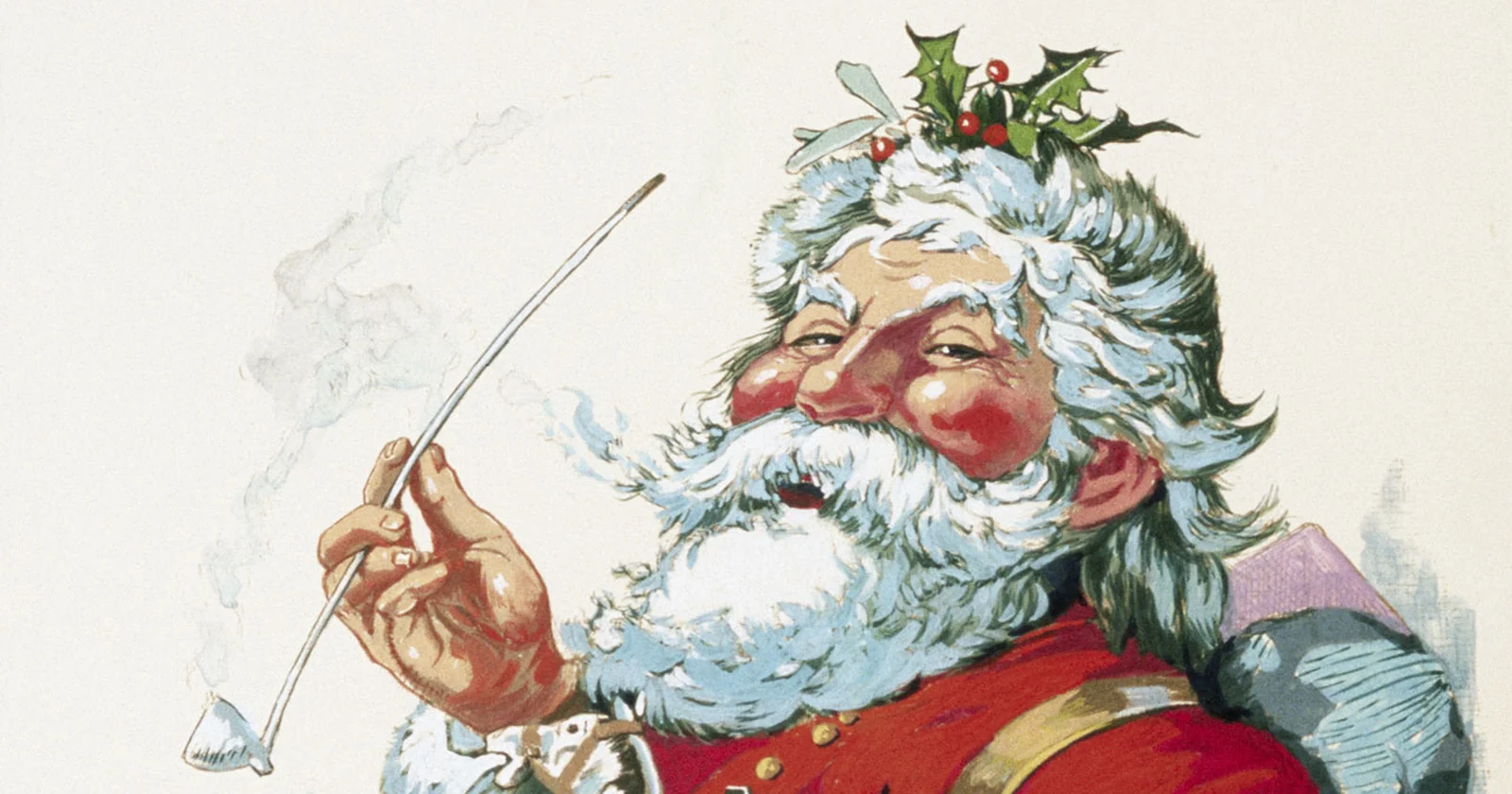
The picture at the top is not a Coke ad at all. It is a color version of Thomas Nast’s “Merry Old Santa Claus,” a drawing that first ran as a black and white engraving in Harper’s Weekly on January 1, 1881. That is fifty years before the first Haddon Sundblom Santa appeared for Coca-Cola. Keep that date in mind as we go.
Santa before the first Coca-Cola Christmas ad
Santa Claus was built by many hands over about a century. In 1822, Clement Clarke Moore wrote “A Visit from St. Nicholas,” the poem most of us know as “‘Twas the Night Before Christmas.” Moore’s St. Nick was a “little old driver, so lively and quick,” small enough to slip down a chimney.
Thomas Nast made him bigger. Nast was the political cartoonist who gave us the Democratic donkey and the Republican elephant, and he drew Santa for Harper’s Weekly for decades. His “Santa Claus in Camp,” on the cover of the January 3, 1863 issue, shows Santa handing out gifts to Union soldiers. By the 1860s, according to the Smithsonian’s National Museum of American History, Nast had turned Santa into a full-sized man with a home at the North Pole.
Coca-Cola’s own history page credits Nast with moving Santa’s coat from tan to red over his 30 years of Christmas drawings. In other words, the company itself does not claim the red suit.
Other advertisers were there early, too. White Rock, the mineral water and ginger ale brand, ran Santa ads in 1915 and 1916, and then color Santa ads in 1923, 1924 and 1925. White Rock’s own site points out that those later Santas look almost the same as the ones Coke used a few years after.
Why a soda company needed a winter salesman
In the early 20th century, soda was a summer drink. People bought cold Coke at the fountain on hot afternoons, and sales sagged when the weather turned. So the company went after winter on purpose. Its 1922 slogan was “Thirst Knows No Season,” and by the 1920s it was running Christmas shopping ads in magazines like The Saturday Evening Post.
The first Santas in those ads were stern, in the style of Nast. Then, in 1930, artist Fred Mizen painted a department store Santa drinking a bottle of Coke in a crowd at the Famous-Barr store in St. Louis. The company calls it the home of the world’s largest soda fountain at the time. That painting ran in The Saturday Evening Post in December 1930.
The idea worked well enough that the company wanted a better Santa. The Smithsonian’s curators put it simply: Coca-Cola turned to Santa because it wanted to sell more soda in the cold months.
Haddon Sundblom and the 1931 Coca-Cola Christmas ad
In 1931, Archie Lee, an executive at the D’Arcy Advertising Agency who worked on the Coca-Cola account, wanted a Santa who felt both real and symbolic. The company hired Haddon Sundblom, a Michigan-born commercial illustrator, to paint Santa himself, not a man in a Santa suit.
Sundblom went back to Moore’s poem for his model. The result was the warm, plump, rosy Santa that most of us picture now. His first Santa ran in The Saturday Evening Post in 1931, and the paintings also showed up in Ladies’ Home Journal, National Geographic and The New Yorker.
The model was a real person. Sundblom painted from his friend Lou Prentiss, a retired salesman. After Prentiss died, Sundblom painted Santa from his own face in a mirror, and later from photographs. Readers watched these ads closely. One year Santa’s belt buckle was on backward, maybe because of the mirror, and another year he had no wedding ring, and people wrote in to ask about Mrs. Claus.
Sundblom painted Santa for Coca-Cola from 1931 to 1964. Over those years Santa read letters, raided refrigerators, played with the toys and stopped for a Coke. In 1942 Sundblom added Sprite Boy, an elf who appeared with Santa through the 1940s and 1950s. The art went onto magazine pages, store displays, billboards, posters and calendars. According to the company, many of the original paintings now hang at the World of Coca-Cola in Atlanta.
Did a Coca-Cola Christmas ad make Santa red?
No. This is the part of the story that gets mixed up most often. The red suit, the white fur trim, the black belt and the big belly were all common before 1931. Snopes points to a 1927 New York Times piece describing a “standardized Santa Claus” in New York, with red garments, white whiskers, ruddy cheeks and a “jolly, paunchy effect.” That was four years before Sundblom’s first painting.
Coca-Cola’s own history page agrees. It says that although people often claim Santa wears red because red is the color of Coca-Cola, Santa wore a red coat before Sundblom ever painted him.
So why does the myth stick? Mostly because of reach. Before television and color newspapers were common, a lot of Americans saw their full-color Santa every year in Coke’s magazine ads, billboards and store displays. Snopes sums it up fairly: Coca-Cola deserves some credit for locking in the modern image, but it popularized a picture it borrowed. Furthermore, the red and white really did match the brand, and the Smithsonian calls that a happy coincidence rather than a plan.
That is a pattern collectors see over and over. The best advertising rarely invents something new. Instead, it takes a familiar picture, makes it a little warmer and repeats it until people think the brand came first.
Polar bears, trucks and Charlie Brown
Santa was not the only winter character. Coca-Cola’s first polar bear showed up in a French print ad in 1922. The bears appeared now and then in print for the next 70 years. Then, in 1993, the “Always Coca-Cola” campaign introduced “Northern Lights,” an animated spot by Ken Stewart. In it, polar bears watch the aurora like a movie and drink Coke. Stewart has said the idea came from his Labrador puppy, who looked like a little polar bear.
In 1995, the agency W.B. Doner made “Christmas Caravan,” the ad with the lighted Coca-Cola trucks rolling through snowy towns to the “Holidays Are Coming” jingle. Each truck was 40 feet long with thousands of bulbs, and Industrial Light and Magic handled the effects. The trucks stayed on screen until 2001, when a real truck tour began in the US.
There is one more holiday tie that surprises people. In 1965, Coca-Cola asked Charles Schulz and producer Lee Mendelson for a Charlie Brown Christmas special. Schulz insisted on keeping Linus reading from the Gospel of Luke and on using real children’s voices. A Charlie Brown Christmas first aired on CBS on December 9, 1965.
What the Coca-Cola Christmas ad says about porcelain signs
The Santa campaign worked because of three simple things: a color you can see from across a room, a friendly face and a message that showed up again and again. Porcelain advertising signs did the same job on store walls and gas station pumps. A red Coke sign by the cooler was a reminder every single day, not just at Christmas. And because the color was fired-on glass, it lasted far longer than printed tin, as our guide to porcelain vs tin signs explains.
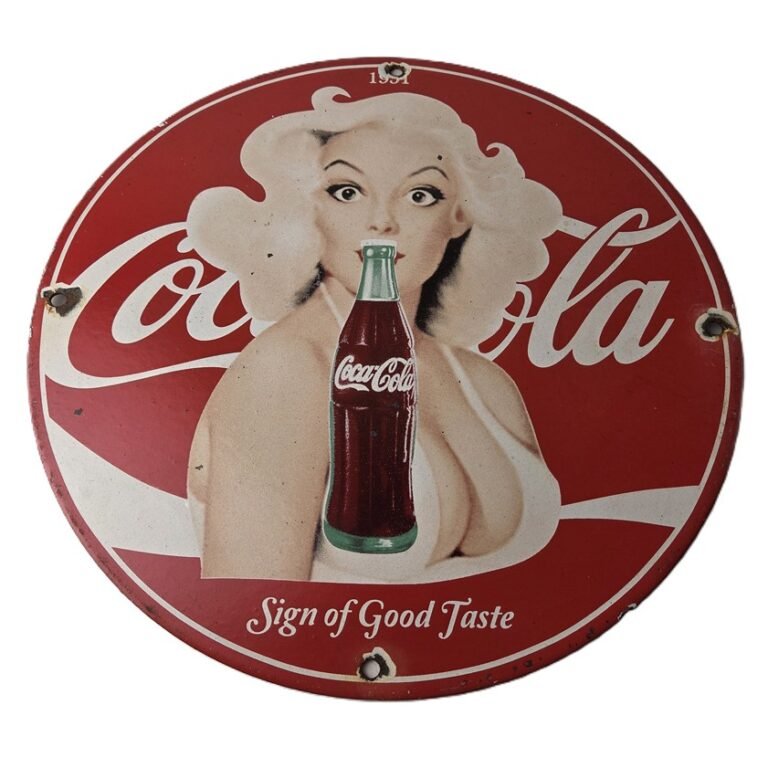
That is why Coke designs are still among the most wanted vintage porcelain signs in any soda collection. They hang well next to a Christmas tree in December, and they still look right in July. For more soda brands with a story, see our roundup of favorite soda and beverage signs. If you are shopping for someone who loves soda history, our Coca-Cola Sign of Good Taste porcelain sign above uses the slogan Coke introduced in 1957, with a pin-up holding a bottle on deep red.
More Coca-Cola porcelain signs for the holidays
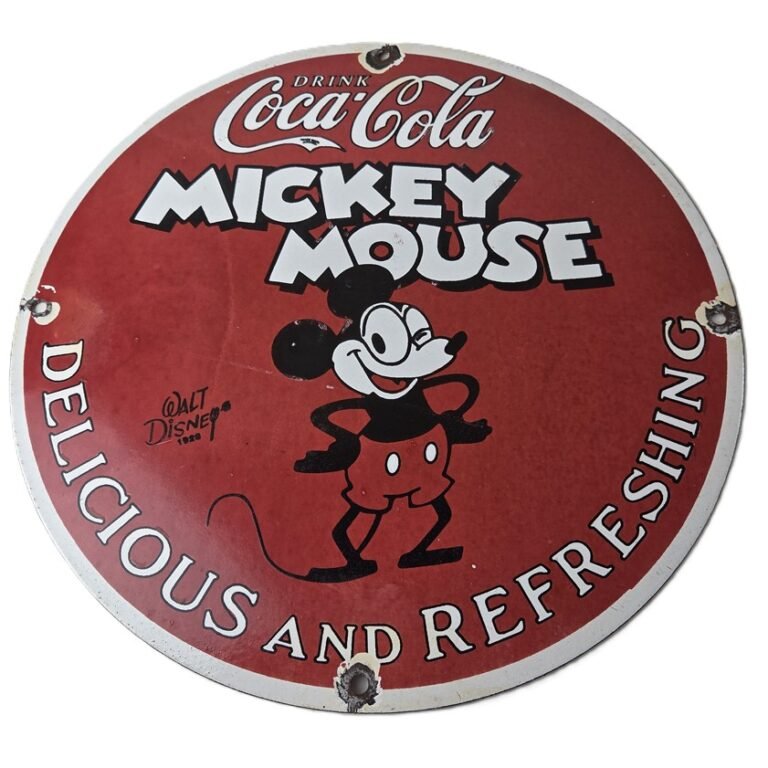
For a Disney fan, the Coca-Cola Mickey Mouse Refreshing sign pairs Mickey with “Delicious and Refreshing,” a Coke slogan from 1904. We also carry the Drink Coca-Cola pin-up in white dress sign and the bright Coca-Cola Marilyn pop art sign. To see everything, browse our Coca-Cola signs or the full soda and diner signs section. Our guide on how to hang porcelain signs helps once the gift is unwrapped.
We ship from Houston, Texas. US orders ship for a flat $10, and international shipping is available at checkout. If a sign is not right, you have 30 days to return it. We pay the return shipping, and you get a full refund.
Coca-Cola, Disney and the other brand names in this post belong to their owners. This article is history and commentary only. We sell porcelain signs that celebrate these brands, and we are not affiliated with any of them.
FAQ: the Coca-Cola Christmas ad
When was the first Coca-Cola Christmas ad with Santa?
Coca-Cola ran Christmas ads in the 1920s, and Fred Mizen’s department store Santa ran in December 1930. Haddon Sundblom’s famous Santa first appeared in 1931.
Did Coca-Cola invent the modern Santa Claus?
No. Moore’s 1822 poem, Thomas Nast’s drawings and many earlier ads had already shaped him, red suit included. Coca-Cola made that image familiar to millions.
Who painted the Coca-Cola Santa?
Haddon Sundblom, from 1931 to 1964. His first model was his friend Lou Prentiss, a retired salesman.
When did the Coca-Cola polar bears and trucks start?
The first polar bear ad ran in France in 1922, and the animated bears arrived in 1993. The lighted truck ad, “Holidays Are Coming,” first aired in 1995.
The featured image is a color version of “Merry Old Santa Claus” by Thomas Nast, first published in Harper’s Weekly on January 1, 1881. It is in the public domain. You can see the full image on Wikimedia Commons.


Add a review
Your email address will not be published. Required fields are marked *