
Why Is Gulf Orange? Gulf Oil Logo History and the Orange Disc
Ask anyone over 50 to picture a Gulf station, and they will describe the same thing: a big orange circle with GULF across it in blue letters. Few brand marks are that easy to remember. This post walks through the Gulf oil logo history, from a kerosene wagon in New Orleans to the race cars at Le Mans, and answers the question people still ask at car shows: why is Gulf orange?
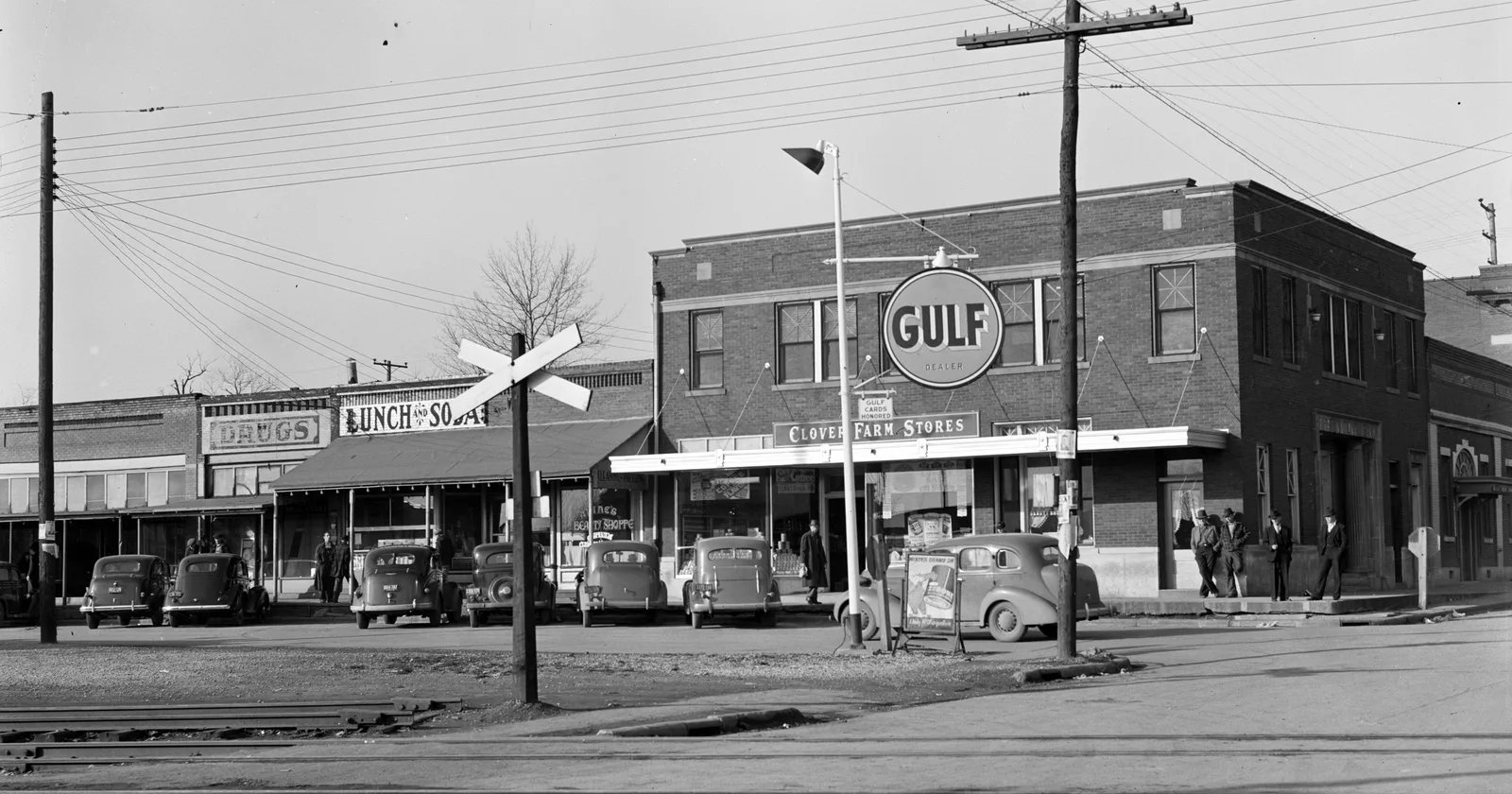
The photo at the top was taken by Arthur Rothstein for the Farm Security Administration in January 1939. It shows a street corner in Carrier Mills, Illinois, a small coal town. Above the Clover Farm grocery hangs a Gulf dealer sign, the orange disc on a pole, lit for night traffic. That sign did its job. Even in a black and white photo you can read it from across the tracks.
Gulf oil logo history starts at Spindletop
Gulf grew out of the Spindletop gusher near Beaumont, Texas, which blew in on January 10, 1901. The flood of crude needed buyers, refineries and capital. So the Mellon family of Pittsburgh stepped in. Gulf Refining Company of Texas was chartered in November 1901, and in 1907 the businesses were combined as Gulf Oil Corporation, based in Pittsburgh. The name pointed back to the Gulf of Mexico, where the oil and the first refinery at Port Arthur were.
In those years, gasoline was a minor product. Kerosene for lamps paid the bills. As a result, the first chapter of the Gulf oil logo history is not about cars at all. It is about lamp oil in a grocery store.
Why is Gulf orange?
According to the company’s own brand history, the color came first and the disc came later. Around 1903, Gulf was selling kerosene in New Orleans. At that time, grocery stores sold kerosene by pumping it into the customer’s own can, and the suppliers were told apart by color. Each company had its own. Gulf wanted one that stood out, so it looked at what the others had taken. Orange was the one color nobody was using, and Gulf claimed it.
That is the short answer. Gulf is orange because orange was free. In other words, it was a practical choice made in a crowded market, long before anyone talked about branding. However, the choice turned out to be a lucky one. Orange reads at a distance, it stands out against green trees and gray streets, and it photographs well. All three things mattered once cars arrived.
The orange disc arrives
Next came the shape. Gulf’s brand page says the orange disc followed a few years later, and several Gulf histories date the disc with the word Gulf across it to about 1920. By then, the gas station had become a real business, and Gulf had helped invent it. On December 1, 1913, Gulf opened a drive-in station at Baum Boulevard and St. Clair Street in Pittsburgh. The Heinz History Center calls it the first drive-in station designed by an architect and built for the job, although a few earlier stations existed. The following year, Gulf began handing out free road maps to drivers, an idea every oil company soon copied.
A circle made sense for a roadside sign. It could hang from a pole, sit on top of a gas pump as a glass globe, or be painted on a tank truck, and it looked the same from any angle. Meanwhile, the bold block letters could be read from a moving car. Gulf registered the mark as a trademark in June 1925. Then, in January 1937, the Patent Office approved the version most people know: the orange disc with blue “Gulf” lettering.
That approval is an important date in the Gulf oil logo history, because it fixed the design that went onto thousands of porcelain signs, pump plates and station roofs in the late 1930s. The sign in our 1939 Carrier Mills photo is one of those. It was only two years old in that design, and it already looked like it had always been there.
Why gas companies sold trust with porcelain
Early gasoline had a bad reputation. Some dealers watered it down or sold whatever was cheapest. Consequently, brand marks on pumps were a promise. If the orange disc was on the pump, the driver expected Gulf fuel and Gulf quality, not a mystery mix from the back of the shed. That is why oil companies spent heavily on signs, and why so many of them chose porcelain enamel. Glass fired onto steel kept its color for decades in sun, rain and road salt. Our guide to porcelain vs tin signs explains why.
Gulf was also good at giveaways. Over the years it handed out road maps, drinking glasses, toys and, in the 1960s, plastic horseshoes for its No-Nox gasoline. The slogan “Good Gulf” ran on signs and ads for years. Each of these put the orange disc in front of the family, not just the driver.
Gulf oil logo history in the air
Gulf also took the orange into the sky. Major Al Williams, who ran Gulf’s aviation department, flew a series of orange stunt planes called Gulfhawks. The Grumman-built Gulfhawk II was delivered in December 1936, and it toured Europe in 1938. Today it is on display at the Smithsonian’s Udvar-Hazy Center in Virginia.
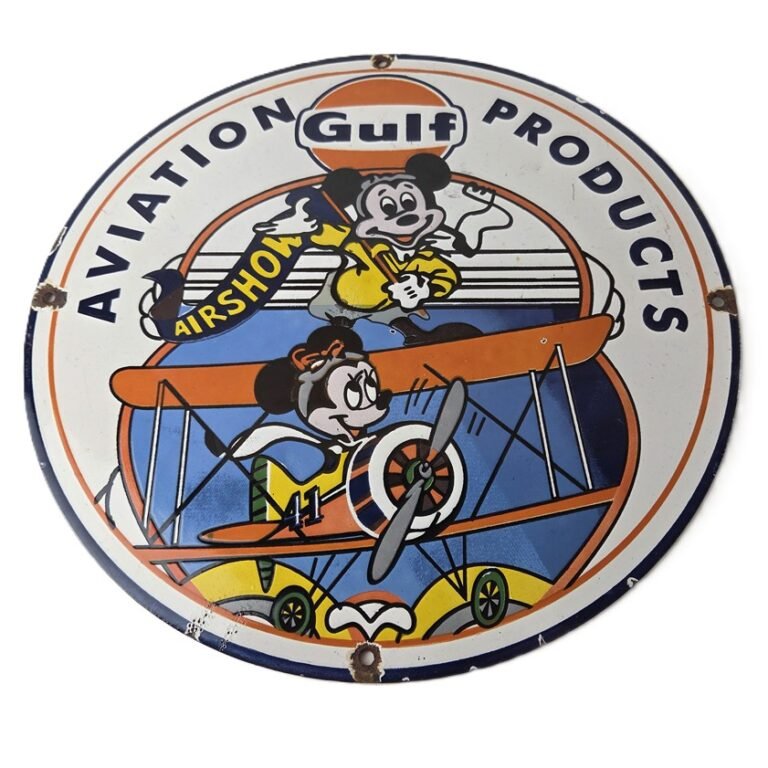
That aviation thread is the idea behind our Gulf Aviation Products Mickey and Minnie porcelain sign. Minnie flies an orange biplane while Mickey waves an airshow banner from the top wing, with the orange and blue Gulf disc above them. It is 12 inches across and makes a good gift for a pilot or a Disney fan.
Gulf oil logo history on the race track
Here is a twist that confuses people. Gulf’s corporate colors were orange and dark navy blue. Yet the racing colors everyone remembers are light powder blue and orange. Where did the light blue come from?
In the late 1960s, Gulf vice president Grady Davis backed John Wyer’s racing team. According to Gulf’s own racing history, the corporate dark blue looked too dull on a race car. So the team used powder blue and orange instead, which were the colors of Wilshire Oil Company, a business Gulf had recently bought.
The result became famous fast. Gulf-sponsored Ford GT40s won the 24 Hours of Le Mans in 1968 and 1969, and the same car, chassis 1075, won both times. Then came the Porsche 917, and in 1971 Steve McQueen drove a light blue and orange 917 in the movie Le Mans. A Gulf Mirage won Le Mans again in 1975. As a result, a whole generation of car fans knows the Gulf colors from racing first and from gas stations second.
What happened to Gulf Oil and its logo?
Gulf stayed independent until 1984, when Standard Oil of California bought it in what was then the largest merger in history. Most Gulf stations in the US were sold off or changed over to Chevron. Even so, the orange disc never went away. Today, Gulf Oil LP holds the brand in the United States, and Gulf Oil International, part of the Hinduja Group, uses it in much of the rest of the world. Both still use the orange disc with blue letters.
That staying power is the real lesson of the Gulf oil logo history. The company changed owners, the products changed, and the stations changed. However, a color picked because nobody else wanted it in 1903 is still on signs more than a century later.
Bring the Gulf oil logo history to the garage
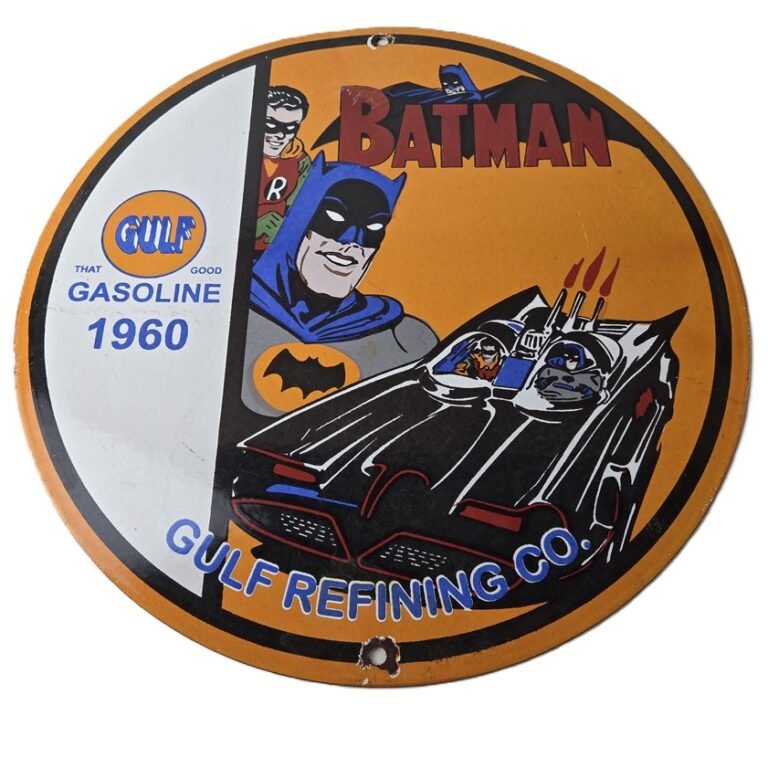
If you collect porcelain signs, Gulf is one of the brands most people want on the wall. The orange is easy to spot across a garage, and it pairs well with almost any other gas brand. Besides the aviation sign above, we carry the Gulf Gasoline Batman and Robin porcelain sign, a 12 inch round with the Dynamic Duo in the Batmobile under the orange disc. It suits a comic fan who also loves old gas stations.
Gulf also looks good next to its old rivals. For example, the Sinclair Dino porcelain sign brings the green dinosaur (here is why Sinclair chose a dinosaur), and the die-cut Mobilgas Pegasus porcelain sign adds the red flying horse. Likewise, the Phillips 66 red shield sign and the tall Shell Free Air sign fill out a station wall. To see more, browse our gas station and motor oil signs, other gasoline signs and garage signs. If you are new to hanging them, our guide on how to hang porcelain signs covers drywall, brick and garage studs.
We ship from Houston, Texas. US orders ship for a flat $10, and international shipping is available at checkout. If a sign is not right, you have 30 days to return it. We pay the return shipping, and you get a full refund.
Gulf and the other brand names in this post belong to their owners. This article is history and commentary only. We sell porcelain advertising signs that celebrate these brands, and we are not affiliated with any of them.
FAQ: Gulf oil logo history
Why is the Gulf logo orange?
Gulf’s own brand history says the company chose orange around 1903 in New Orleans, when kerosene suppliers were told apart by color. Orange was the only color no other supplier was using.
When did the Gulf orange disc first appear?
A few years after the color, and several Gulf histories put the disc with the Gulf name at about 1920. It was registered as a trademark in 1925, and the familiar disc with blue lettering was approved by the Patent Office in January 1937.
Why are Gulf racing colors light blue instead of dark blue?
Gulf’s corporate navy looked too dull on race cars in the late 1960s. Therefore, the team used the powder blue and orange of Wilshire Oil, a company Gulf had acquired.
Is Gulf Oil still around?
Yes. Gulf was bought by Standard Oil of California in 1984, but the brand lives on with Gulf Oil LP in the US and Gulf Oil International elsewhere.
The featured photo is “Street corner. Carrier Mills, Illinois,” by Arthur Rothstein, January 1939, from the Library of Congress FSA/OWI Collection, with no known restrictions on publication. You can see the full photo at the Library of Congress.

Add a review
Your email address will not be published. Required fields are marked *