

Why Is the Chevy Logo a Bowtie? Four Origin Stories
The Chevy bowtie is one of the most recognized car emblems in the world. It sits on the grille of every Silverado, Corvette and Tahoe, and it has been on Chevrolets for more than 110 years. Yet nobody can say for sure where it came from. Even the company’s own historians admit the story is a mystery. There are at least four origin stories, and two of them come from inside the founder’s own family. Here they are, with the dates and sources behind each one.
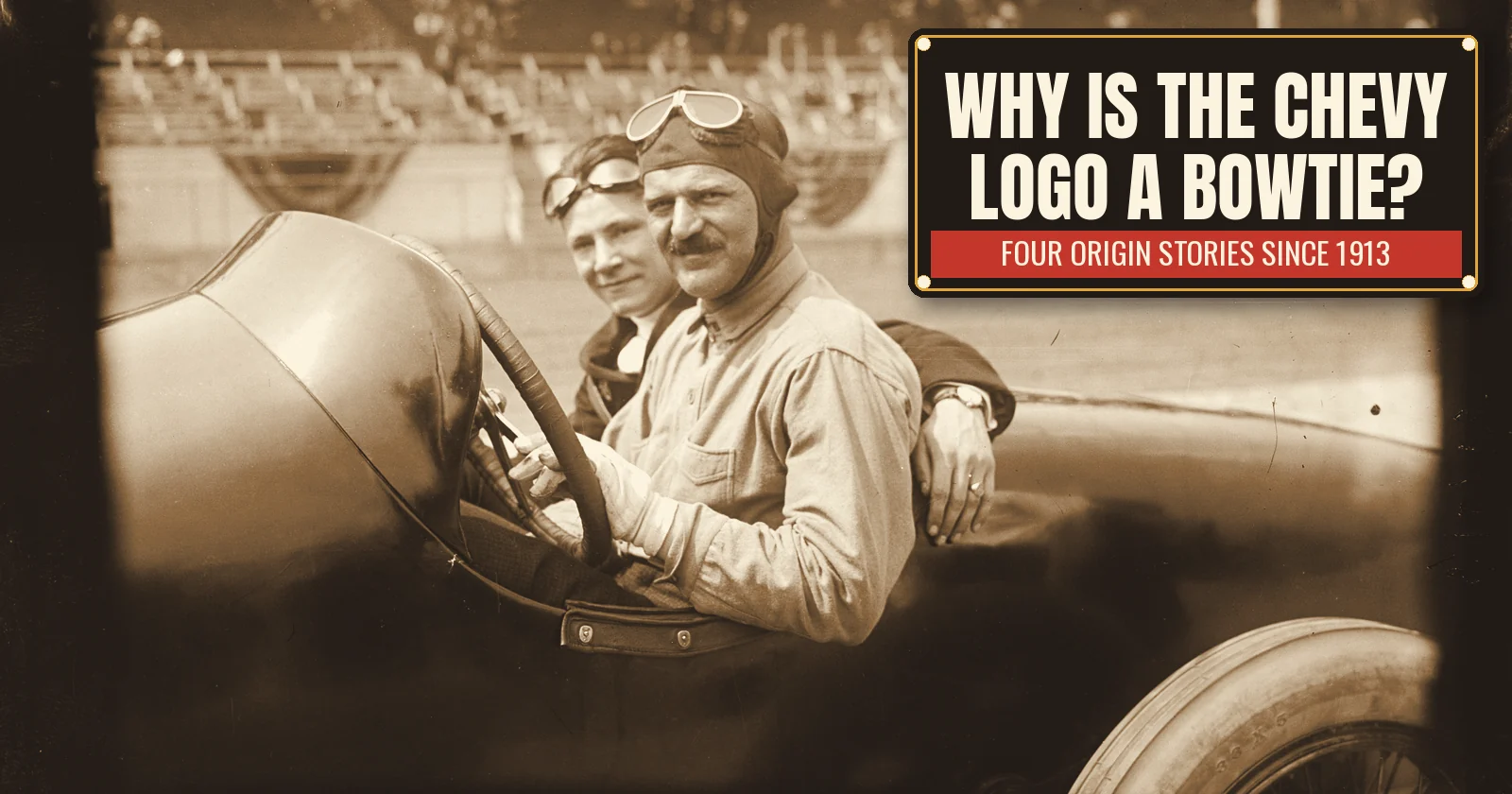
The photo at the top comes from the Bain News Service and is dated 1916. The Library of Congress caption reads only “Chevrolet.” It shows a mustached driver in goggles at the wheel of a race car with a riding mechanic beside him, and it is believed to show Louis Chevrolet, the Swiss-born racer whose name went on the car. By 1916 Louis had left the company that carried his name and gone back to building and racing his own cars.
Two men and a name
Chevrolet started with two very different people. William C. Durant was a businessman from Flint, Michigan. He had built a huge carriage business, then founded General Motors in 1908, and then lost control of it. Louis Chevrolet was a famous race driver and mechanic. Durant needed a new car company, and he liked the sound of a racer’s name on it.
The Chevrolet Motor Company was incorporated in Detroit in November 1911. Louis designed the first car, but the partnership did not last. The two men disagreed about what kind of car Chevrolet should build, and Louis soon left. Durant kept the name, and the company grew fast enough that he used it to win back control of General Motors.
That is the background. The bowtie came in late 1913, introduced by Durant himself. The question is where he got the idea.
Story one: the Chevy bowtie on hotel wallpaper
This is the official version, and Durant himself told it. In 1961, for Chevrolet’s 50th anniversary, the company published a book called The Chevrolet Story. It said the emblem “originated in Durant’s imagination when, as a world traveler in 1908, he saw the pattern marching off into infinity as a design on wallpaper in a French hotel.” According to the book, he tore off a piece of the wallpaper and kept it to show friends, thinking it would make a good nameplate for a car.
It is a great story. It also has a problem. Nobody has ever found the wallpaper, and no one has matched the pattern to a hotel.
Story two: a sketch at the dinner table
The second version comes from Durant’s daughter, Margery. In 1929 she published a book called My Father. She wrote that Durant liked to doodle nameplate designs on scraps of paper at dinner. “I think it was between the soup and the fried chicken one night that he sketched out the design that is used on the Chevrolet car to this day,” she wrote.
This story does not exactly rule out the first one. A man could see a pattern in Paris and then sketch his own version years later. Still, it is a different picture from the torn wallpaper.
Story three: a newspaper ad in Hot Springs
The third story is the most interesting, because a historian actually went looking for proof. In 1986, Chevrolet’s dealer magazine printed a story based on an interview with Durant’s widow, Catherine, recorded 13 years earlier. She remembered a 1912 vacation in Hot Springs, Virginia. While reading a newspaper in their hotel room, her husband spotted a design and said, “I think this would be a very good emblem for the Chevrolet.”
She did not say what the design was. So Ken Kaufmann, a historian and editor of The Chevrolet Review, went searching. He found an ad in the November 12, 1911 issue of The Constitution, the Atlanta newspaper. It was for “Coalettes,” a refined coal fuel sold by the Southern Compressed Coal Company, and its logo was a slanted bowtie shape very close to the one Chevrolet soon used. That paper came out just nine days after Chevrolet was incorporated. Did Durant see the same ad, or one like it, a year later in Virginia? Nobody knows, but the shapes are close.
Story four: the Swiss flag
The last theory points to Louis Chevrolet’s homeland. He was born on Christmas Day 1878 in La Chaux-de-Fonds, in the Swiss canton of Neuchâtel, to French parents. Some people think the bowtie is a stretched and slanted version of the cross on the Swiss flag, as a tribute to him.
It is a nice idea. However, there is no record that Durant or anyone at Chevrolet ever said so. Since Louis left the company around the time the emblem appeared, this one is the hardest to back up.
The first Chevy bowtie ad
Whatever the source, the date is firmer. According to General Motors, the earliest known use of the bowtie to sell the brand is an ad in The Washington Post on October 2, 1913. Above the emblem, it says “Look for this nameplate.” Within a few years, the bowtie had become the definitive Chevrolet logo.
The colors and details have changed many times since then, and dealers, ads and grilles have shown it in many colors and finishes. In 2004, Chevrolet began phasing in the gold bowtie that now serves as the brand mark worldwide. Through all of it, the basic shape never changed. That is rare. Many car companies have redrawn their logos completely, but the bowtie is still the bowtie.
The Chevy bowtie on porcelain signs
As Chevrolet dealers spread across the country, the bowtie went up over service bays and used car lots. Those dealer signs were often porcelain advertising signs, glass enamel fired onto steel, because the colors held up in the weather. If you want to know how oil brands used vintage porcelain signs too, our gas station logo history covers the big names.
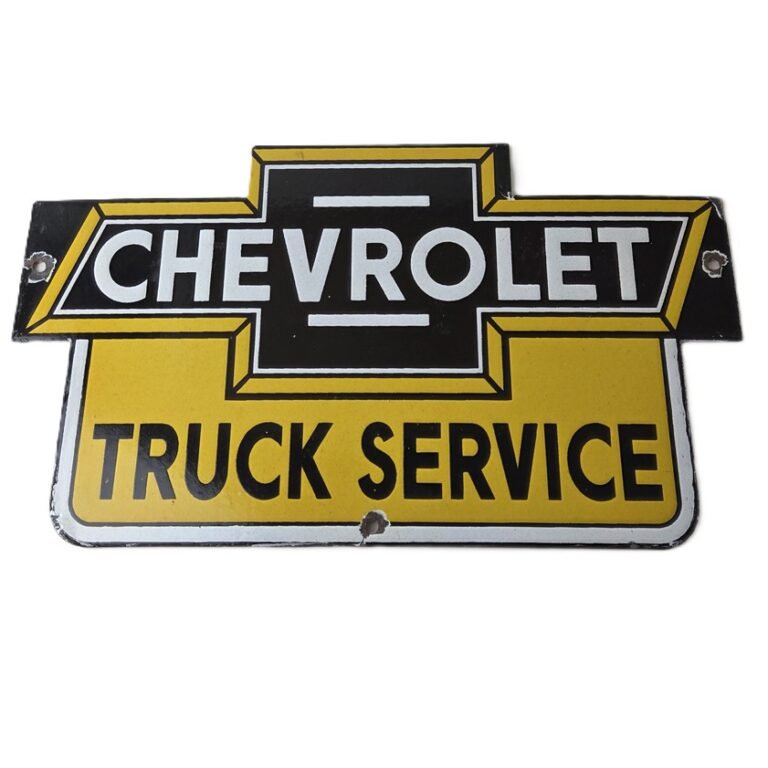
The Chevrolet Truck Service porcelain sign is cut in the shape of the bowtie itself, with white Chevrolet lettering on the black center and bold Truck Service lettering on a yellow panel. It measures 12 by 7 inches, with porcelain on the front and back.
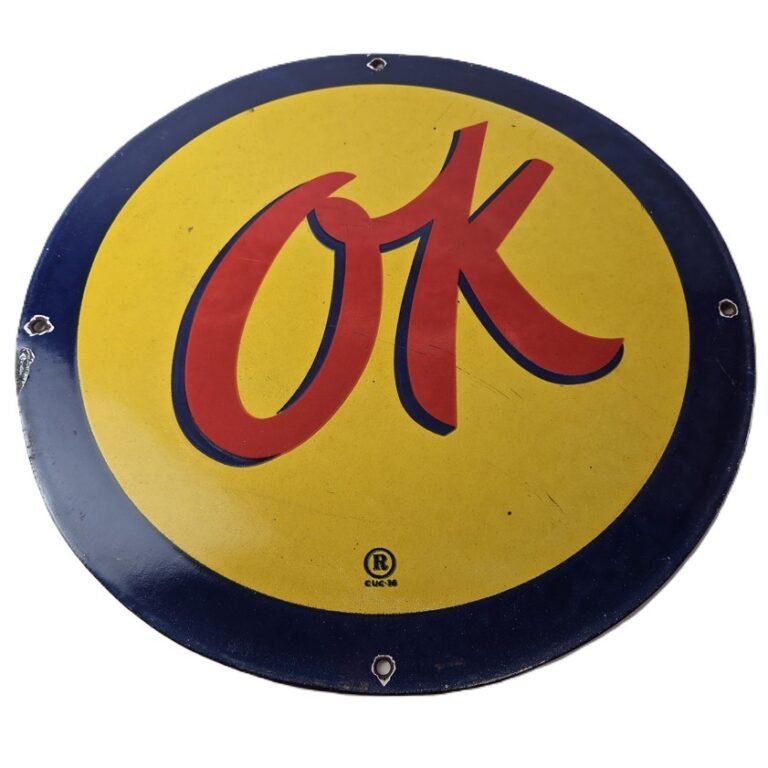
The Chevrolet OK Used Cars porcelain sign recalls another dealer tradition. Chevy dealers put the red OK on used cars that had been inspected and reconditioned. This one is a 12 inch round with the red OK script on a yellow center and a deep blue rim.
More vintage porcelain signs for Chevy fans
For the muscle car crowd, the Camaro SS porcelain sign and the Camaro Racing Team sign both fit a garage with a Camaro in it. Truck people might also like the GMC Trucks “Truck of Value” sign from Chevy’s sister brand. You can see every design in our Chevrolet signs, along with the wider car and truck signs and garage signs. For gift ideas, see our list of gifts for car guys. When it is time to put one up, our guide on how to hang porcelain signs covers drywall, brick and garage studs.
We ship from Houston, Texas. US orders ship for a flat $10, and international shipping is available at checkout. If a sign is not right, you have 30 days to return it. We pay the return shipping, and you get a full refund.
Chevrolet, the Chevrolet bowtie emblem, Camaro, GMC and General Motors are trademarks of their respective owners. This article is history and commentary only. We sell porcelain advertising signs, and we are not affiliated with or endorsed by any company named here.
FAQ
Why is the Chevy logo a bowtie?
Nobody knows for certain. Durant said he copied a wallpaper pattern from a French hotel in 1908. His daughter said he sketched it at dinner, his widow said he saw it in a newspaper, and some people link it to the Swiss flag.
When did Chevrolet first use the bowtie?
William C. Durant introduced it in late 1913. The earliest known ad with the emblem ran in The Washington Post on October 2, 1913.
Is the Chevy bowtie based on the Swiss flag?
It is one theory, since Louis Chevrolet was born in Switzerland. There is no record that the company ever said so.
When did the Chevy bowtie turn gold?
Chevrolet began phasing in the gold bowtie in 2004. Before that, its colors and details changed many times, but the shape stayed the same.
Sources include General Motors’ “History with a Mystery: The Chevrolet Bowtie” (2011), which you can read in full here. The featured photo is “Chevrolet,” Bain News Service, 1916, from the Library of Congress, with no known restrictions on publication. You can see the full photo at the Library of Congress.




Add a review
Your email address will not be published. Required fields are marked *