

Pin-Up Girl Art: From the Gibson Girl to WWII Nose Art and Porcelain Signs
Pin-up girl art is older than the word for it. The term “pin-up” was first recorded in English in 1941, but artists had been drawing idealized American women for magazines, calendars and ads for decades before that. Then the war came, and the same pictures ended up on locker doors, barracks walls and the noses of bombers. Here is a short history, from the Gibson Girl to the gas station sign.
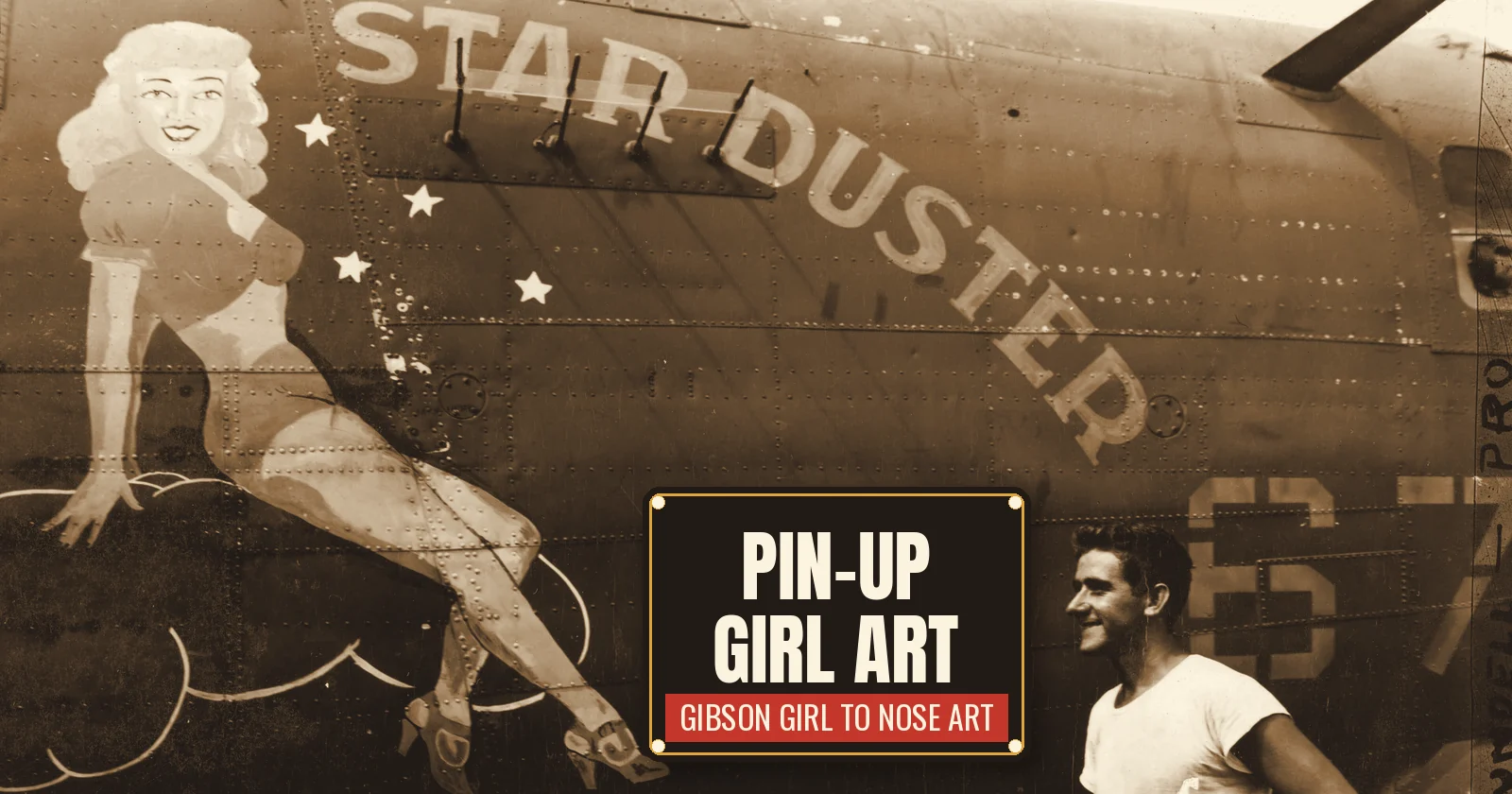
The photo at the top was taken on Guadalcanal on April 9, 1944, by an Army Signal Corps photographer, S/Sgt. Mundell. A ground crew chief, Master Sergeant Richard Hardin of Rockland, Maine, stands smiling beside a B-24 Liberator named “Star Duster.” A blonde in heels sits on a painted cloud, with a few white stars scattered around her. The original Army caption says it plainly: “Pin-up girl influence is apparent on many of the Army’s Liberator bombers.”
Before pin-up girl art had a name
People were passing around pictures of attractive performers long before 1941. In the 1800s, burlesque dancers and actresses handed out small photo cards to promote their shows. Those cards ended up tucked into mirror frames and pinned up backstage.
The first great drawn version came from Charles Dana Gibson. In the 1890s he created the Gibson Girl, a pen-and-ink woman who was tall, stylish and confident. She rode bicycles, swam, played tennis, and never looked lewd. For about 20 years, into the 1920s, she was the American ideal.
The Gibson Girl matters because she was not a real person. Instead, she was an idea, drawn over and over. That made her the model for everything that followed. Later artists kept the same trick of a woman who looked like the girl next door, only a little more perfect.
Esquire and the Petty Girl
Esquire, a men’s magazine founded in 1933, soon became the home of pin-up girl art. Its first star artist was George Petty, born in 1894 in Abbeville, Louisiana. He painted his long-legged “Petty Girls” with an airbrush, a tool he first learned to use in his father’s photo shop in Chicago.
Petty also helped invent a format. His Esquire gatefolds started the magazine centerfold, a picture that folded out to full size. As a result, the art was easy to tear out and hang. Later, during the war, crews copied Petty Girls onto their planes. The most famous is the B-17 “Memphis Belle,” whose nose art is a Petty Girl talking on a phone.
Vargas and pin-up girl art at war
Alberto Vargas took over as Esquire’s best-known pin-up painter. He was born in Arequipa, Peru, in 1896, and came to the United States in 1916. Before Esquire, he painted for the Ziegfeld Follies and for Hollywood studios.
Between 1940 and 1946, Vargas produced 180 paintings for the magazine, known as “Vargas Girls.” They were wildly popular with servicemen. In fact, Esquire sent millions of free copies to American troops overseas. The government was less amused. The Post Office tried to take away the magazine’s second-class mailing permit over its cartoons and Vargas art, and Esquire fought it all the way to the Supreme Court and won.
After the war, Vargas lost a legal fight with Esquire over the name “Varga.” He struggled until 1959, when Playboy began running his work. Over the next 16 years he painted 152 more pictures for that magazine.
Nose art: pin-up girl art goes to the front
Nose art means a painting on the front of a military plane. It started with squadron emblems in World War I. However, World War II is usually called its golden age.
The pictures were not officially approved, even where nobody enforced the rules. That was part of the appeal. Crews felt close to their planes, and many believed a good painting brought luck. Often the work was done by ground crews or by an airman who could paint. Some artists became well known. For example, Tony Starcer of the 91st Bomb Group painted more than a hundred B-17s, including the “Memphis Belle.”
Most of the pin-ups were borrowed. Crews copied or adapted the Esquire pin-ups of Vargas and Petty onto American and Allied planes again and again. Similarly, they painted calendar girls onto aircraft by the hundreds. A girl riding a bomb, a blonde on a cloud, a name in big letters along the side. The “Star Duster” in our photo is a textbook example.
Gil Elvgren and the calendar years
If one painter defines the classic look of pin-up girl art, it is Gil Elvgren. He was born in St. Paul, Minnesota, in 1914 and studied at the American Academy of Art in Chicago. He learned from Haddon Sundblom, the artist behind Coca-Cola’s famous Santa Claus ads.
In 1937 Elvgren started painting calendar pin-ups for Louis F. Dow. Crews copied many of those onto warplanes, too. Then, around 1944, the calendar company Brown & Bigelow came calling. He worked with them from 1945 to 1972 and painted on 30 by 24 inch canvases for the rest of his career.
He worked like a film director. From 1951 he painted in a studio at his home in Winnetka, Illinois, with an assistant who set the lights, built props and photographed each scene before he painted it. Meanwhile, his commercial clients included Coca-Cola, General Electric and Sealy. That mix of art and advertising is exactly why pin-ups and porcelain advertising signs feel so natural together.
The pin-up photo
Not every pin-up was painted. In 1943, actress Betty Grable posed for studio photographer Frank Powolny in a one-piece bathing suit, looking back over her shoulder. The shot became the most requested photo among American servicemen. That same year she was the world’s top box-office draw.
In other words, Grable’s poster showed that a photograph could do what Vargas and Petty did with an airbrush. After the war, pin-up photos and paintings carried on side by side for years.
Pin-up girl art on porcelain signs
Today, a lot of people meet pin-up girl art through vintage porcelain signs on a garage wall. The look fits, because both came out of the same mid-century world of gas stations, soda fountains and calendars hanging at the parts counter. If you are planning that wall, our guide to man cave and garage decor has layout and theme ideas.
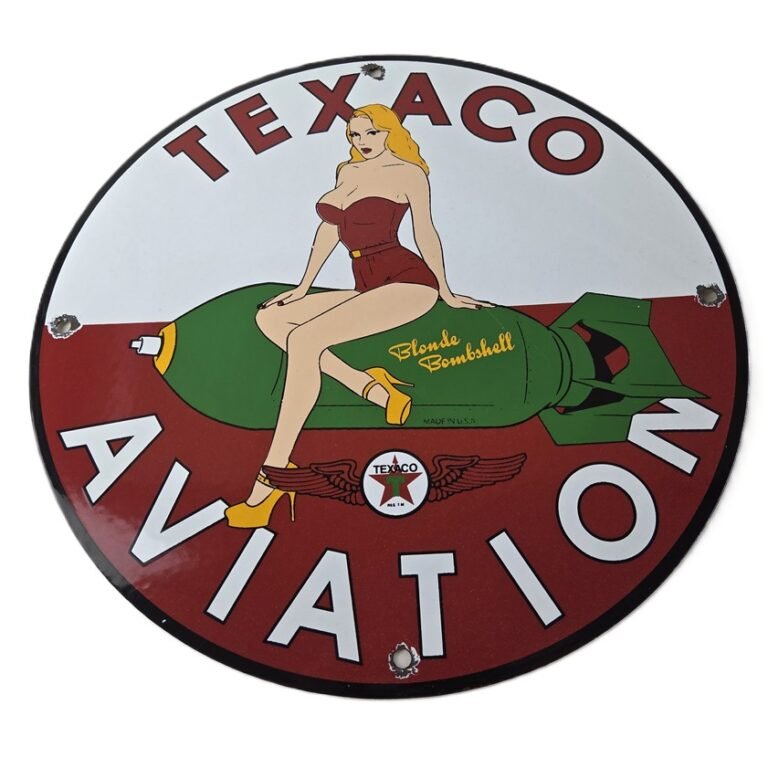
Our Texaco Aviation Blonde Bombshell porcelain sign borrows straight from nose art, with a pin-up sitting on a green bomb. It is 11 3/4 inches across, with glossy porcelain on the front and back.
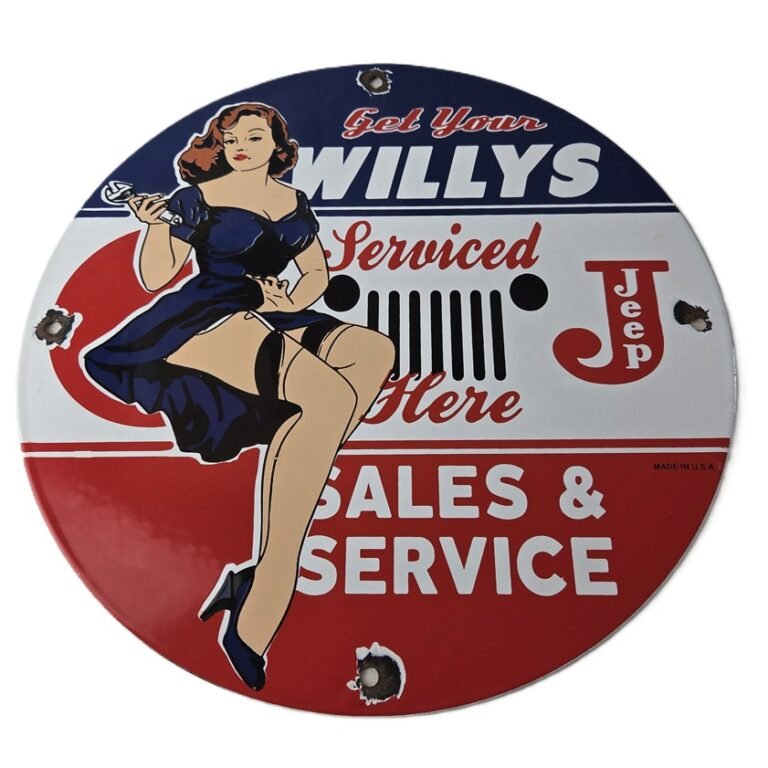
For a Jeep owner, the Jeep Willys Sales & Service porcelain sign has a pin-up girl in blue under “Get Your Willys Serviced Here.” It is 11 3/4 inches across.
More porcelain signs with pin-ups
There are plenty more. The Texaco Aviation propeller plane sign pairs a pin-up with a red plane, and the STP Racer’s Edge sign suits a race fan. You can see them all in our pin-up girl signs, along with our aviation signs and man cave signs. Once yours arrives, our guide on how to hang porcelain signs covers drywall, brick and garage studs.
We ship from Houston, Texas. US orders ship for a flat $10, and international shipping is available at checkout. If a sign is not right, you have 30 days to return it. We pay the return shipping, and you get a full refund.
Texaco, Jeep, Willys, STP, Esquire, Playboy and Coca-Cola are trademarks of their respective owners. This article is history and commentary only. We sell porcelain advertising signs, and we are not affiliated with or endorsed by any company named here.
FAQ: pin-up girl art
When did the term pin-up first appear?
The word “pin-up” was first recorded in English in 1941, although the idea of hanging pictures of glamorous women goes back to the 1800s.
Who were the most famous pin-up artists?
Charles Dana Gibson, George Petty, Alberto Vargas and Gil Elvgren are the big four for most collectors. Petty and Vargas made their names at Esquire, and Elvgren at the calendar firm Brown & Bigelow.
Why did World War II bombers have pin-up girls?
Nose art was unofficial, so it let crews personalize their planes and remind themselves of home. Many believed it brought luck, and Esquire pin-ups were easy to copy.
Who was the most popular pin-up of World War II?
Betty Grable. Her 1943 bathing suit photo by Frank Powolny became the most requested photo among American servicemen.
The featured photo shows M/Sgt. Richard Hardin beside the B-24 Liberator “Star Duster” on Guadalcanal, April 9, 1944, by S/Sgt. Mundell, U.S. Army Signal Corps. As a work of the U.S. Army, it is in the public domain. You can see the full photo on Wikimedia Commons.


Add a review
Your email address will not be published. Required fields are marked *