

The Ford Logo Through the Years: Script, Oval and Blue
The Ford blue oval is so familiar that it is easy to think it was always there. It was not. Ford’s first cars carried a fancy script with an art nouveau border. The oval started in Britain, a triangle with wings showed up for a few years, and the blue oval did not reach a Ford hood as standard until the 1970s. This Ford logo history follows the company’s own heritage timeline, with a few other sources for the later years.
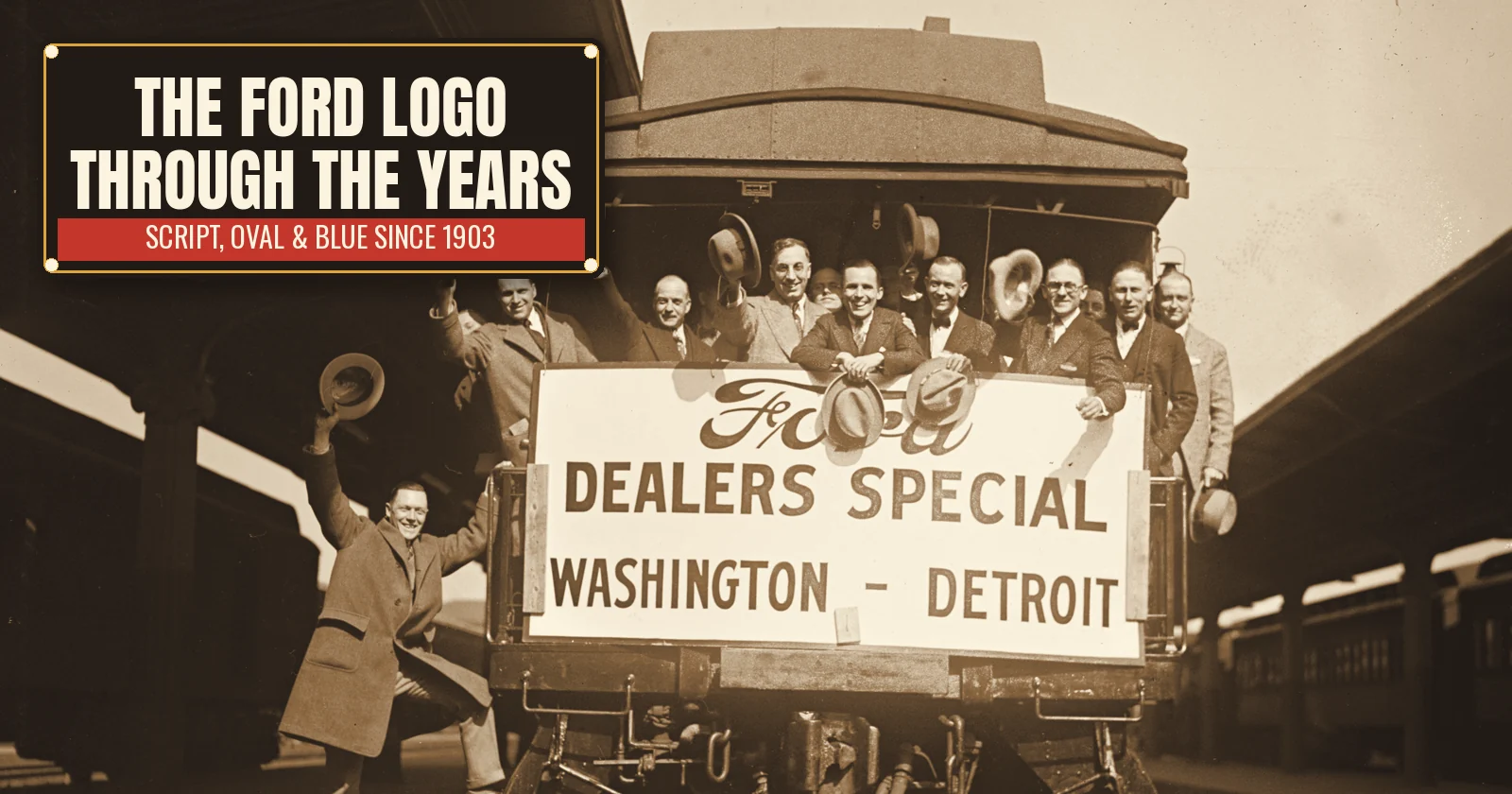
The photo at the top was taken in 1926 by the National Photo Company. The Library of Congress caption reads “Ford dealers, Ford Co.” A crowd of men lean out of a railroad car and wave their hats, and a banner on the car reads “Ford Dealers Special, Washington – Detroit.” Look closely at the Ford name on that banner. It is the script, not the oval. In 1926 the blue oval as we know it was still a year away from its first car.
Ford logo history starts with a script, 1903
Henry Ford founded the Ford Motor Company in Detroit in 1903. According to Ford’s heritage timeline, the first logo that year was a script on the original Model A, set inside an ornate border with art nouveau decoration. It looked more like a fine label than a car badge.
The script most people know came soon after. Ford credits it to Childe Harold Wills, one of Henry Ford’s first engineers. He is said to have drawn the Ford script using lettering from his grandfather’s stencil set. In 1906 a version with “wings” appeared, and Ford used it until the end of 1910. The script itself was registered with the U.S. Patent Office in 1909.
The first oval came from Britain, 1907
Here is a surprise. The oval was not a Detroit idea at first. In 1907, Ford’s British agents, Perry, Thornton and Schreiber, began using an oval as a “hallmark for reliability and economy,” according to Ford. It was a selling mark more than a badge on the car.
By 1911 the script and the oval came together. Even so, the plain script kept showing up on Ford vehicles until the late 1920s. So if you see an early Ford, a Model T for example, with only the script, that is right for the time.
The winged triangle, 1912
For a short time Ford tried something very different. In 1912 it used a blue triangle with wings, carrying the words “The Universal Car,” in orange or dark blue. According to Ford, Henry Ford himself did not like it, and it did not last long.
The idea came back in an unexpected way more than a century later. In August 2025, Ford revived the winged triangle for its new electric vehicle platform, which it calls the Universal EV Platform. It is a good example of how old marks stay in a company’s memory.
The blue oval arrives, 1927
The big change came with the new Model A. In 1927 it became the first Ford car to wear the oval badge, with the script on a royal blue background. That is the look most people picture when they think of a Ford. The company used that badge on its cars until the late 1950s.
Then something strange happened. From the late 1950s to the mid-1970s, the oval mostly disappeared from Ford hoods and grilles. Dealers and ads still used it, but on many cars of that era you will find the Ford name spelled out in block letters instead.
During those years, Henry Ford II even looked at replacing it. In 1966 he hired Paul Rand, the famous designer of logos for IBM and ABC, to draw a new Ford mark. Rand came back with an updated design, but Ford turned it down. The script in the oval stayed.
Back on every Ford, 1976
In 1976, the blue and silver oval went back onto Ford vehicles, and it has been on all of them since. That is why Ford logo history feels so steady to most drivers. If you were born after 1976, you have probably never seen a new Ford without it.
The oval has been updated in small ways since then. Around 2000, under chief executive Jacques Nasser, the company called the script its “trustmark” and leaned on it in ads. Then on June 17, 2003, for Ford’s 100th birthday, the company introduced what it called the Centennial Blue Oval, a slightly refreshed version with a deeper blue. Most people never noticed the change, which was the point.
A quick guide to dating Ford logos
If you collect Ford items, or just like to look closely at old photos, the timeline above makes a handy cheat sheet:
- Script in a fancy border: the very first logo, 1903.
- Script with wings: 1906 to the end of 1910.
- Winged triangle, “The Universal Car”: 1912, and only briefly.
- Script inside an oval on royal blue, on the car: from the 1927 Model A to the late 1950s.
- Block letters on the hood, no oval: common from the late 1950s to the mid-1970s.
- Blue and silver oval on every vehicle: from 1976, refreshed as the Centennial Blue Oval in 2003.
Keep in mind that dealers, parts counters and ads did not always switch at the same time as the cars, so use this as a guide, not a rule.
Ford logo history on porcelain signs
For most of the 20th century, Ford dealers and parts counters hung porcelain advertising signs. Glass enamel fired onto steel held its color for decades, which mattered for a sign hanging over a service bay. That is why so many collectors know the blue oval from old dealer photos, and why vintage porcelain signs with Ford logos are some of the most popular in any garage. We also cover other brand stories in our gas station logo history.
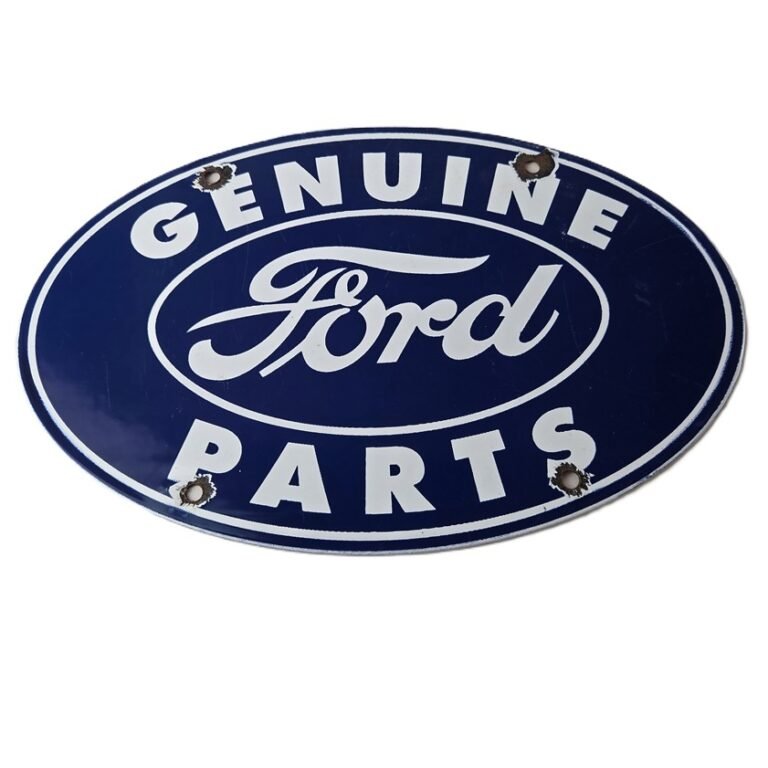
The Ford Parts blue oval script porcelain sign is an oval itself, with the white Ford script inside a white ring and bold Parts lettering around it. It is classic Ford blue and white, 11 3/4 by 7 3/4 inches, with porcelain on the front and back.
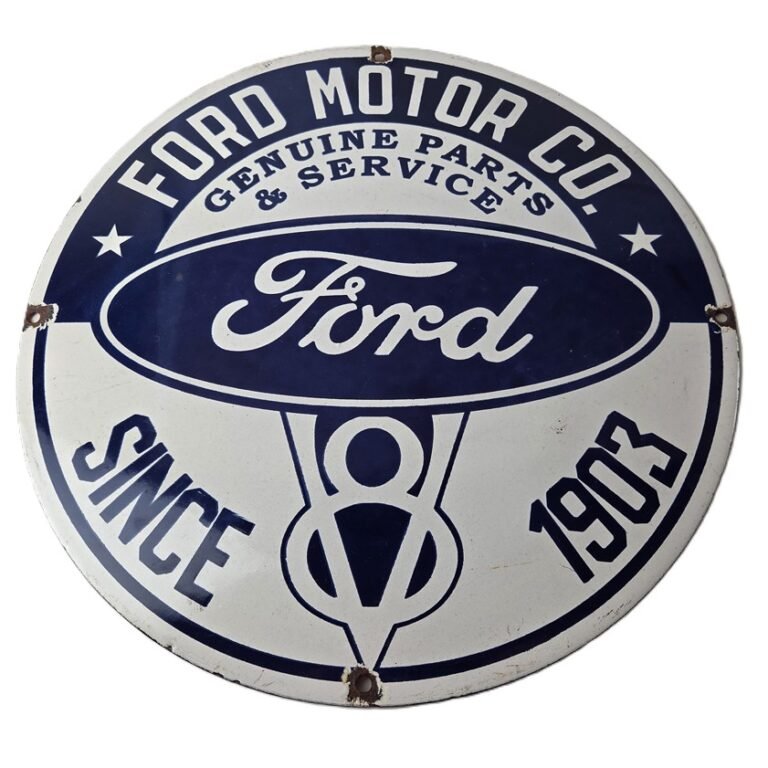
The Ford Motor Co. V8 Parts and Service porcelain sign puts the script in a navy oval above a big V8 emblem, with “Since 1903” split around it. Ford introduced its flathead V8 in 1932, and it made fast, affordable power part of everyday driving. The sign is 12 inches across.
More porcelain signs for Ford fans
Mustang owners can pick the running pony and tri-bar sign or the Mustang Parts & Accessories sign. Truck people will like the Ford Trucks blue pickup grille sign, and off-road fans can go with the Ford Bronco bucking bronco sign. There is also a Ford “Born in Detroit” sign for anyone with Motor City roots. Browse them all in our Ford signs, or see the wider car and truck signs and garage signs. Shopping for a Ford fan? Our list of gifts for car guys has more ideas, and our guide on how to hang porcelain signs covers drywall, brick and garage studs.
We ship from Houston, Texas. US orders ship for a flat $10, and international shipping is available at checkout. If a sign is not right, you have 30 days to return it. We pay the return shipping, and you get a full refund.
Ford, the Ford Blue Oval, Mustang, Bronco and the other names in this post are trademarks of their respective owners. This article is history and commentary only. We sell porcelain advertising signs, and we are not affiliated with or endorsed by Ford Motor Company or any other company named here.
FAQ
When did Ford start using the blue oval?
Ford’s British agents first used an oval in 1907. The script and oval were combined by 1911, and the 1927 Model A was the first Ford car to wear the blue oval badge.
Who designed the Ford script logo?
Ford credits Childe Harold Wills, one of its first engineers. He is said to have used lettering from his grandfather’s stencil set.
Why did the Ford oval disappear from cars?
From the late 1950s to the mid-1970s, Ford mostly left the oval off hoods and grilles. It returned to all Ford vehicles in 1976.
Has the Ford logo changed recently?
Only a little. Ford introduced the Centennial Blue Oval on June 17, 2003, and in 2025 it brought back the 1912 winged triangle for its Universal EV Platform.
The main source for this Ford logo history is Ford’s own history and heritage timeline. The featured photo is “Ford dealers, Ford Co.,” National Photo Company Collection, 1926, from the Library of Congress, with no known restrictions on publication. You can see the full photo at the Library of Congress.




Add a review
Your email address will not be published. Required fields are marked *